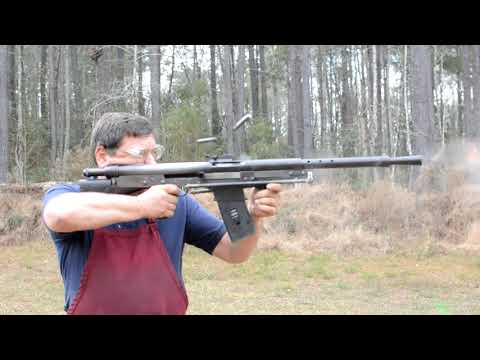
Operational Physics: Anvil 069

Published on July 7, 2022
Duration: 17:44

This video delves into the physics of firearm operation, contrasting recoil-operated systems (like the M11) with gas-operated systems (like the AR-15). It explains Newton's Third Law of Motion as the fundamental principle governing firearm recoil and action cycling. The discussion highlights how manipulating mass and spring tension affects the speed and efficiency of a firearm's operation, emphasizing the critical role of time in the extraction process. The presenter uses analogies and demonstrations to illustrate these concepts, providing valuable insights for understanding firearm mechanics.

Quick Summary

Firearm operation is governed by Newton's Third Law (action-reaction) and the equation F=MA. Recoil-operated firearms use backward momentum, while gas-operated firearms use tapped gases to cycle. Increasing mass slows cycling, while decreasing mass speeds it up. Time is crucial for safe extraction after firing.

Chapters

  1. 00:00Introduction: M11 vs. AR-15 Physics
  2. 00:39Newton's Third Law: Action & Reaction
  3. 00:55Two Ways Propellant Energy is Used
  4. 01:13Recoil Operation Explained
  5. 01:36Gas Operation Explained
  6. 01:50Recoil Operation: M11 Example
  7. 01:57Gas Operation: AR-15 Example
  8. 03:22The Core Equation: F=MA
  9. 03:45Understanding Acceleration and Jerk
  10. 04:14Firearm Forces: Cartridge vs. Spring
  11. 04:42The Importance of Time in Extraction
  12. 05:12Spring vs. Propellant Forces
  13. 05:45Mass, Acceleration, and Time Relationship
  14. 06:25Mass Increase = Time Increase
  15. 06:55Rocket Analogy for Action Cycling
  16. 07:12Demonstrating Mass and Spring Effects
  17. 07:47Adding Mass to Demonstrate Slowing Action
  18. 08:16Slow Motion Analysis of Operation
  19. 08:48Effect of Increased Gas Pressure
  20. 09:02Low Pressure vs. High Pressure Demonstration
  21. 09:28Long Recoil vs. Gas Operation History
  22. 09:51Summary: Balancing Forces and Speed
  23. 10:26Conclusion: Homework is Essential

Frequently Asked Questions

What is the fundamental physics principle behind firearm operation?

The fundamental physics principle is Newton's Third Law of Motion: for every action, there is an equal and opposite reaction. This explains how the forward expulsion of a projectile creates backward recoil in the firearm, which is then harnessed to cycle the action.

How do recoil-operated and gas-operated firearms differ in their mechanics?

Recoil-operated firearms, like the M11, use the backward force of the fired cartridge to move the barrel and bolt rearward. Gas-operated firearms, like the AR-15, tap expanding gases from the barrel to push a piston or bolt carrier, initiating the cycling process.

What is the relationship between mass, acceleration, and firearm cycling speed?

According to F=MA, if the force from the propellant is constant, increasing the mass of the reciprocating components (bolt, carrier) will decrease acceleration, leading to slower cycling. Conversely, decreasing mass increases acceleration and cycling speed.

Why is time a critical factor in firearm operation?

Time is critical for safe extraction. After firing, the cartridge must remain sealed in the chamber until the internal pressure drops to a safe level. This delay prevents case ruptures and allows for reliable cycling.

Related News

All News →

More Training & Techniques Videos You Might Like

More from Mark Novak

View all →