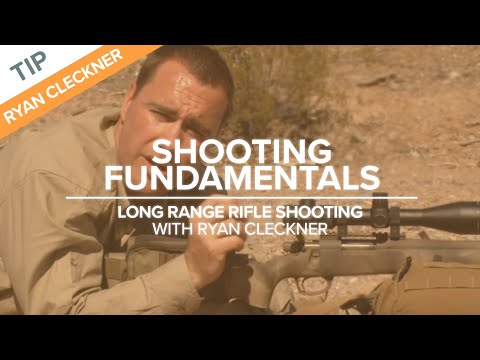
Scope Tracking Drill | Long-Range Rifle Shooting with Ryan Cleckner

This video demonstrates the 'box drill' to test rifle scope tracking accuracy. Ryan Cleckner explains how external turret adjustments should correspond to internal reticle movement. By firing shots in a box pattern, shooters can verify their scope's tracking performance and identify potential zeroing issues, ensuring consistent point-of-impact for precision shooting.

Quick Summary

The 'box drill' tests rifle scope tracking by firing shots in a box pattern around a center point using incremental turret adjustments. This verifies that external adjustments accurately move the internal reticle, ensuring consistent point-of-impact for precision shooting.

Chapters

  1. 00:00Introduction to Scope Tracking
  2. 00:42The Box Drill Explained
  3. 01:26Executing the Scope Tracking Drill
  4. 03:48Analyzing Scope Tracking Results
  5. 04:27Tips for Precision & Safety

Frequently Asked Questions

What is the 'box drill' for rifle scopes?

The 'box drill' is a method to test rifle scope tracking. You fire a shot, then make specific turret adjustments (e.g., up, right, down, left) to create a box pattern around the initial shot, all while maintaining the same point of aim.

How do I know if my rifle scope is tracking correctly?

If your scope tracks correctly, the shots should form a consistent pattern (like a box) corresponding to your turret adjustments. A slight overall shift might indicate a need to adjust your initial zero, but the scope itself is likely functioning properly.

What does MOA mean in scope adjustments?

MOA stands for Minutes of Angle. It's a unit used for scope adjustments, where 1 MOA typically moves the point of impact about 1 inch at 100 yards. Precision scopes use MOA or MRAD for fine-tuning.

What is the relationship between turret adjustments and reticle movement?

The relationship is key to scope tracking. External turret adjustments should precisely move the internal reticle, changing where the bullet hits relative to the aiming point. Testing this ensures your scope's adjustments are accurate and repeatable.

Related News

All News →

More Training & Techniques Videos You Might Like

More from NSSF—The Firearm Industry Trade Association

View all →