Chris from Regular Guy Training explains his handgun zeroing process, emphasizing starting at 3 yards to establish height over bore and windage before moving to the final zero distance (typically 25 yards). He details how to measure and adjust sights, and the importance of understanding personal shooting tendencies for consistent accuracy.
This video demonstrates a practical method for zeroing a rifle, focusing on a 100-yard zero, which is versatile for hunting and PRS-style shooting. The process involves initial bore sighting for a rough alignment, followed by a 25-yard group to confirm the rifle's ability to group, and finally, fine-tuning the zero at 100 yards. The instructor emphasizes the importance of ensuring the rifle groups before attempting to zero and highlights how environmental factors like wind can affect the process.
This video details the instructor's personal zeroing philosophy for rifles and pistols, emphasizing the practical implications of different zero distances. The instructor advocates for a 100-yard zero for rifles, citing its simplicity in managing holdovers and holdunders across various distances, particularly with scoped carbines. For pistols, a 25-yard zero is preferred to mitigate unexpected impacts at distance. The content is geared towards intermediate shooters seeking to optimize their firearms for practical application.
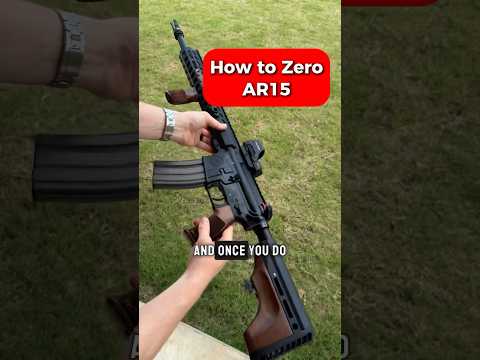
This video provides a practical guide on how to zero an AR-15 using the Tactical Elites Sight Right 2.0 bore sighting kit. The instructor, demonstrating high authority, explains the importance of zeroing optics to prevent embarrassing misses or accidental damage to range equipment. The process involves using the bore sight's laser to achieve a rough zero at 25 yards before live fire.
This guide details how to zero rifle optics when limited to shorter range distances, using the 'Infinite Zero Targets' website. It covers generating custom targets, analyzing shot groups at 25 yards, and calculating optic adjustments based on a 1-inch grid. The instruction comes from SHORTSHOT TONY, an experienced shooter and content creator, offering practical advice for achieving accuracy.
Ben Stoeger advocates for zeroing pistol red dot sights at 25 yards for practical shooting. This distance aims to minimize the need for holdovers at common engagement ranges up to 50 yards. He emphasizes that while mechanical offset is a factor at close range, a 25-yard zero provides a predictable point of impact for most scenarios without requiring complex aiming adjustments.
This video debunks the myth that a 25-yard zero is ineffective. The speaker, demonstrating high authority, explains that a 25-yard zero can provide a point-of-aim, point-of-impact relationship out to 300 yards, making indoor ranges with 25-yard limitations perfectly suitable for achieving a reliable firearm zero.
This video provides a beginner-friendly guide to zeroing an AR-15 rifle, explaining the importance of a zero and demonstrating the process at 25 yards. It covers common zero distances, stable shooting techniques in the prone position, and how to make optic adjustments based on group analysis. The instructor emphasizes understanding ballistic trajectory and practicing at various ranges to master holdovers and holdunders.
This guide details a comprehensive process for zeroing LPVOs and red dot sights on AR-15 platforms, emphasizing a data-driven approach over arbitrary zeros. It covers using chronographs and ballistic calculators to determine optimal zeros based on ammunition, optic type, and intended engagement distances, moving from a rough zero to a base zero and then to a fine-tuned zero like Point Blank Zero or reticle-aligned holds. The process concludes with live-fire confirmation.
This guide details how to sight in a break barrel airgun, emphasizing the use of a fresh target at 25 yards and firing multiple shots to establish a baseline. It explains how to adjust elevation and windage, highlighting the ease of adjustment with ATN scopes due to their dual reticle system, while also providing principles for standard scopes. The process aims for a dead-on zero for accurate shooting.
This video demonstrates the process of zeroing an LPVO on a Daniel Defense MK18 SBR using a 25-yard zero. The instructor emphasizes that this is not a recommendation for the 'best' zero but a demonstration of popular methods to extend effective range. They highlight the importance of understanding how ammunition, optics, and height over bore interact with wind conditions to achieve consistent hits at various distances.
Scott Jedlinski of Modern Samurai Project explains the nuances of red dot zeroing for pistols. He clarifies the 10 vs. 25-yard zero debate, stating practical application dictates the choice, with 10 yards often sufficient for self-defense. Jedlinski emphasizes that marksmanship, the firearm, and ammunition are more critical for accuracy than the specific zero distance. He also provides practical advice on refining the zero using 1-inch squares and shooting from a standing position, along with tips on dot brightness and calling shots.
Gun Laws by State
Read firearms regulations for all 50 states + D.C.
Find Gun Dealers
Search licensed FFL dealers near you.