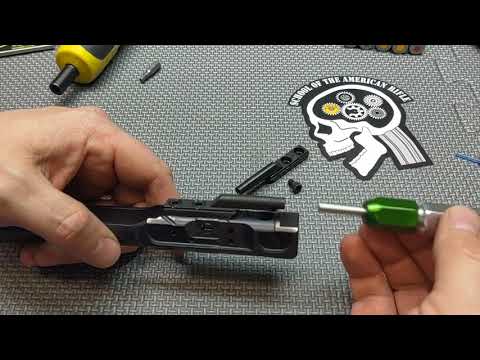
This video announces a new service from School of the American Rifle offering physical inspections and 'autopsies' for AR-15 style bolt carrier groups (BCGs). For a fee of $40 labor plus shipping and processing costs, customers can send in their BCGs to be assessed for proper function, protrusion, and headspace, receiving a detailed health report. The service is limited to AR-15 platforms and requires specific payment and packaging instructions.
This video provides a detailed inspection of three Expo Arms chrome AR-15 bolt carrier groups (BCGs). The instructor performs a series of tests, including checking for proper staking, measuring dimensions like carrier length and bolt protrusion, and inspecting critical components like extractors and firing pin holes. Minor issues such as slightly undersized extractor pockets and a misaligned carrier key are identified, with recommendations for correction. The overall assessment highlights the quality of the BCGs, particularly their internal finish and staking.
This video provides a critical, expert-level inspection of a problematic AR-15 Bolt Carrier Group (BCG) by Chad Albrecht of School of the American Rifle. The analysis details numerous manufacturing defects, including an undersized bolt tail, excessive firing pin protrusion, oversized firing pin and cam pin holes, and a failing headspace check. The content highlights the importance of precision gauging in identifying critical failure points that impact rifle reliability and safety.
This video provides an in-depth, expert-level examination and upgrade procedure for Young Manufacturing Bolt Carrier Groups (BCGs). Lead Firearms Instructor and SEO Strategist details a comprehensive inspection process covering headspace, extractor function, ejector pins, firing pin protrusion, and bolt face integrity. The guide includes step-by-step instructions for replacing worn components with upgraded parts like Michigan Made optimized carry key screws, Sprinco ejector springs, and spiral coil pins, along with modifications to ensure proper fit and function. It emphasizes critical checks and potential failure points, offering practical solutions for common issues encountered with BCGs.
This guide details how to inspect the bore of a bolt carrier group (BCG) for surface roughness using a borescope. Significant roughness in the gas ring area can lead to premature wear or failure of the gas rings. The video emphasizes that even high-quality BCGs, like those from BCM, can occasionally have manufacturing defects. It suggests using budget-friendly borescopes for home inspection and performing gas ring tension tests as a complementary diagnostic.
This video provides a detailed inspection and partial disassembly of a Palmetto State Armory (PSA) chrome-lined, phosphate-coated M16-cut bolt carrier group (BCG). The instructor meticulously checks various components, including gas rings, ejector, extractor, firing pin, cam pin, bolt face, and gas key staking, using specialized gauges and tools. Key findings include a weak extractor spring, a non-beveled ejector edge, and a failure in the gas key staking during a reverse torque test, indicating potential issues with proper torque application and staking. The instructor plans to replace the gas key, screws, and springs to bring the BCG up to standard.
This video focuses on physical examinations or inspections of two JP Enterprises FMOS BCGs (Bolt Carrier Groups). While the description is brief, the title suggests a detailed look at the components, potentially covering aspects like materials, machining, finishing, or any notable physical characteristics of these specific BCGs. It's likely aimed at AR-15 enthusiasts interested in high-quality or specialized parts for their builds.
This video provides an in-depth physical inspection of two Young Manufacturing Bolt Carrier Groups (BCGs), one standard and one National Match. The instructor, from the School of the American Rifle, meticulously examines various components, including the carrier, bolt, firing pin protrusion, cam pin, extractors, and gas key alignment. Several potential issues are identified, such as short firing pin protrusion on one bolt and gas key alignment problems on the standard carrier, highlighting the importance of detailed inspection for optimal firearm function.
This guide details a comprehensive physical inspection and testing procedure for a Toolcraft Nickel Boron Bolt Carrier Group (BCG). It covers checking gas ring integrity, carrier bore measurements, gas key staking, borescope inspection of internal finishes, bolt component checks, firing pin protrusion, and headspace. The process highlights potential issues like excessive wear, uneven coating application, and critical dimensional tolerances that can affect firearm reliability.
This video provides a detailed physical inspection of a Bootleg adjustable bolt carrier group (BCG). The instructor examines various components including the bolt, firing pin, extractor, and carrier key, performing critical measurements like headspace and firing pin protrusion. Key findings include poor staking of the carrier key fasteners (YFS fasteners), potential nickel boron coating on the firing pin, and a rough bolt face. The video also demonstrates testing the integrity of the YFS fasteners under torque and checking for gas leakage.
This video provides a detailed physical inspection of a Knight's Armament Sandcutter Bolt Carrier Group (BCG). It covers essential checks like bolt protrusion, extractor function, headspace, and gas ring integrity using various gauges. The instructor also performs a reverse torque test on the carrier key screws and identifies minor gas leakage, leading to a recommendation for carrier key replacement and proper staking.
This video provides a detailed physical inspection of a new Hodge bolt carrier group (BCG) by School of the American Rifle. It covers the nitride finish quality, firing pin protrusion measurement, extractor and ejector function checks, magnetism testing, and internal carrier bore inspections using a borescope and specialized gauges. The instructor highlights the refined finish of the Hodge BCG and discusses the implications of internal bore tolerances for gas efficiency.
You've reached the end! 12 videos loaded.
Gun Laws by State
Read firearms regulations for all 50 states + D.C.
Find Gun Dealers
Search licensed FFL dealers near you.