This video documents a chaotic incident at a gas station involving a robbery attempt, a federal agent's intervention, and subsequent police involvement. It highlights the complexities of civilian and law enforcement response to armed confrontations, emphasizing threat assessment, de-escalation, and the legal parameters of using force. The narrative underscores the importance of situational awareness and proper procedure when encountering volatile situations, particularly those involving firearms.
This guide details the installation and use of the StopBox, a mechanical handgun retention device. It emphasizes its battery-free operation and versatile application in home, workshop, and outdoor scenarios. The video showcases its utility for quick access while performing various activities, highlighting its unique 5-button mechanical interface for secure storage.
This video strongly advises against using Kydex-only holsters without a Level III retention system for duty belt setups, drawing on 12 years of active duty infantry experience. The instructor emphasizes that while Kydex holsters are suitable for concealed carry or flat range use, duty applications require a hood and thumb release to prevent accidental firearm loss during physical activity, vehicle egress, or combat scenarios. The video highlights the importance of training with these retention systems to ensure quick and reliable access when needed.
This video from Active Self Protection analyzes an incident where an uncooperative suspect, armed with a Glock 22, escalated a confrontation by attempting to draw a firearm. Hosts John Correia and Mike Willever break down the tactical decisions and response times of the officers involved, highlighting the predictable outcome when a suspect resists lawful commands and presents an immediate threat. The analysis emphasizes the importance of officer training and situational awareness in de-escalating or resolving such dangerous encounters.
This video analyzes a Dallas PD bodycam incident where a felon pulled a gun on officers. John Correia, a recognized self-defense expert, breaks down the tactical decisions, the failure of a Taser due to clothing, the effectiveness of a contact shot, and emphasizes the critical need for clear tactical planning before engaging a suspect. The analysis highlights the extreme risks involved in such confrontations.
This guide demonstrates the use of a magnetic holster system for attaching firearms and magazines to a plate carrier, as shown by tactical gear content creator Johnny Q. The system utilizes strong magnets for quick access and secure retention, suitable for tactical applications.
This video provides a practical guide to one-handed handgun manipulation, crucial for scenarios where a shooter's dominant hand is injured. It details the process of drawing, reloading, and clearing malfunctions using only the non-dominant hand, emphasizing the importance of securing the firearm between the legs for stability and leveraging available surfaces to rack the slide. The instruction highlights prioritizing cover when available, as re-engagement may be slower with one-handed operation.
This expert-level guide from USCCA instructor Zach details a critical close-quarters firearm draw technique. It emphasizes creating a shield with the non-dominant hand, drawing the weapon while establishing distance with the firearm itself, and then creating further distance with body movement by circling away. This multi-faceted approach aims to prevent the attacker from gaining control of the weapon and allows the defender to effectively engage.
This analysis breaks down a self-defense incident where a store clerk was disarmed by an armed robber. Instructor John Correia, a martial arts expert, emphasizes the critical need for empty-handed skills, ground fighting, and situational awareness for firearms carriers. Key takeaways include prioritizing hands for defense over electronics and understanding weapon retention during grapples.
This video details an incident where an off-duty female police officer successfully defended herself against an attacker attempting to steal her open-carry handgun. The narrative emphasizes the firearm as an equalizer, particularly for women facing physically superior assailants. It also highlights the critical importance of concealed carry insurance due to potential civil lawsuits, even after lawful self-defense, and advises against open carry due to increased risk of targeted attacks.
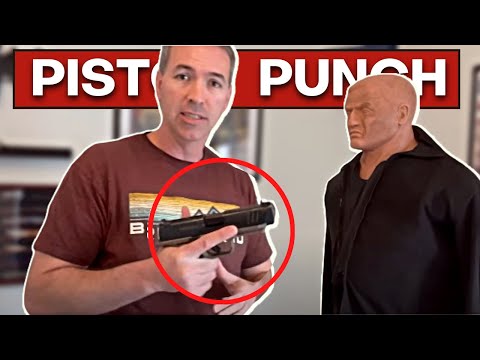
This video demonstrates how to use a handgun as an impact weapon when it malfunctions or runs out of ammunition in a close-quarters self-defense scenario. Former CIA officer Jason Hanson explains that in situations like active shooter events or carjackings, it can be faster to strike an attacker with the firearm than to clear a malfunction. The technique involves maintaining a firm grip and using the pistol to strike vital areas like the face or throat.
This analysis breaks down a self-defense incident where a car dealer successfully deterred a robbery attempt without firing his weapon. It highlights the importance of situational awareness, proper firearm carry and draw techniques, and responsible use-of-force decision-making. The video also emphasizes the critical need for immediate medical preparedness with trauma kits. Instruction is provided by recognized experts in the self-defense community.
Gun Laws by State
Read firearms regulations for all 50 states + D.C.
Find Gun Dealers
Search licensed FFL dealers near you.