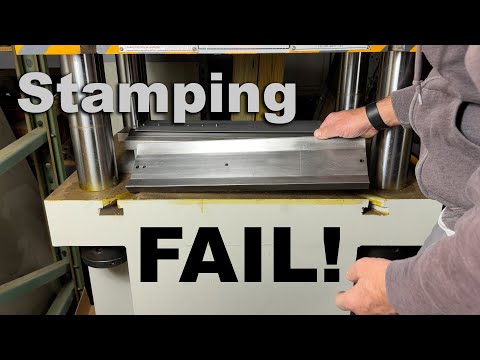
This video details a failed attempt at stamping a firearm component using a 120-ton hydraulic press. Mark Serbu, owner of Serbu Firearms, highlights the critical importance of precise material alignment and die design in sheet metal stamping. The demonstration showcases common pitfalls, such as misalignment leading to skewed parts, and the challenges of achieving complex bends with simple dies. Serbu emphasizes that learning from failures is integral to the engineering process.
This video demonstrates the deconstruction of a 40mm L/70 HE-PFPX M822 anti-aircraft round using a hydraulic press. The process reveals the projectile's internal structure, highlighting the tungsten sphere fragmentation matrix, epoxy filler, cast Octol explosive, and the M766 proximity fuze. The expert presenter, with high authority signals including access to specialized equipment and technical schematics, provides a clinical and demonstrative explanation of the ammunition's components.
This video provides an expert-level unboxing and initial assessment of a Dake 150-ton Hydraulic Press, highlighting its USA manufacturing and robust capacity. The speaker, demonstrating high authority in shop tools and fabrication, emphasizes the importance of quality equipment for professional environments. Key features like the 150-ton gauge and 'Made in USA' origin are showcased.
This guide details the process of stamping a firearm receiver using a hydraulic press, as demonstrated by Mark Serbu. It covers material preparation, the stamping process itself, and inspection of the finished part. The video highlights the advantages of stamped steel over machined aluminum for firearm receivers, emphasizing durability and manufacturing efficiency. Instruction is provided by a professional firearm designer and manufacturer.
Mark Serbu demonstrates the process of designing and fabricating sheet metal dies to stamp firearm components, inspired by the WWII-era Sturmgever. He details the challenges of die creation, including machining and heat treatment, and showcases the successful stamping of a component using a 200-ton hydraulic press. The video highlights the potential for efficient manufacturing through stamping compared to traditional CNC machining of aluminum.
This guide outlines the key steps involved in building an AKM-style rifle from a parts kit, as demonstrated in Brandon Herrera's first build class. It covers receiver preparation, barrel pressing for headspacing, riveting critical components like the trunnion and trigger guard, and final assembly. The process emphasizes precision and safety, particularly during the headspacing and riveting stages, culminating in a range test to ensure functionality.
This guide details the experimental process of assembling an AK-pattern receiver using only dimples for trunnion retention, bypassing traditional rivets. It highlights the mechanics of dimpling and the subsequent live-fire test, which ultimately resulted in catastrophic failure, underscoring the critical role of rivets in structural integrity. The video features an expert firearm builder demonstrating advanced techniques and the consequences of deviating from proven methods.
Brandon Herrera, a professional AK manufacturer, provides a realistic guide to building AK-pattern rifles at home. He details the significant tooling investment required, estimating basic tooling costs around $1,056 for finished receivers and more for building from flats. Herrera emphasizes the complexity compared to AR-15 builds and advises that it's only worthwhile if building multiple rifles, while also touching on legal considerations for home builds.
Mark Serbu demonstrates a home-shop button rifling process using Chinese and Ukrainian rifling buttons on 4140 and 12L14 steel barrel blanks. The video details the use of a hydraulic press and Moly grease, concluding with a comparison of the 4-groove rifling from the Chinese button and 6-groove from the Ukrainian button. Serbu provides expert insights into material selection and the practicalities of DIY barrel making.
This guide details a DIY attempt at rifling a barrel blank, as demonstrated by Mark Serbu. It covers the critical steps of machining, heat treatment, tempering, and bore preparation. The process highlights the challenges and potential failures associated with using low-quality tooling, emphasizing the need for proper equipment and technique for successful home gunsmithing.
You've reached the end! 11 videos loaded.
Gun Laws by State
Read firearms regulations for all 50 states + D.C.
Find Gun Dealers
Search licensed FFL dealers near you.