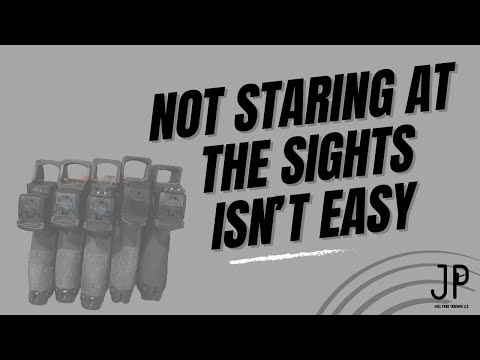
This video critically examines the effectiveness of point shooting versus using sights (iron or red dot) for pistol engagement. It argues that while point shooting may have niche applications, proper sight acquisition and a solid index point are crucial fundamentals for all shooters, especially for self-defense and competitive scenarios. The discussion highlights that red dot sights simplify aiming by requiring focus on the target, offering a clear advantage over iron sights which demand more complex alignment.
This video critiques the advice of a social media personality regarding point shooting with red dot sights. The instructor emphasizes that effective red dot shooting involves focusing on the target, bringing the gun to the eyeline, and confirming sight alignment, even at close distances. He argues that relying solely on point shooting without sight confirmation is a disservice to new shooters and can lead to accountability issues, especially under stress.
This video critiques a common misconception about red dot sight usage, emphasizing that well-trained shooters focus on the target and superimpose the dot, rather than actively searching for it. It advocates for a consistent grip and index to ensure the dot appears where intended, promoting a target-focused shooting methodology.
This video emphasizes that simply shooting ammunition at the range without a specific training goal may not lead to improvement. Instructor Joel Park demonstrates how to identify performance issues during live fire, such as grip problems or slow reloads. He then advocates for using dry-fire practice to isolate and correct these specific weaknesses before returning to live fire for reassessment, promoting a cyclical approach to skill development.
This video provides guidance for intermediate shooters looking to increase their speed and aggressive movement. The instructor emphasizes that significant improvements in shooting speed are achieved through consistent dry fire practice, focusing on efficiency and pushing personal limits with par times. He advises against rushing live fire without proper dry fire preparation and highlights the importance of being comfortable with failure during practice to facilitate learning and growth.
This video documents a USPSA shooter's experience at a match, focusing on mental approach and technical adjustments. Key takeaways include adopting a positive 'what to do' mindset, improving trigger splits, lowering the center of gravity for better movement, and maintaining momentum. The shooter also discusses strategies for engaging steel targets and efficient movement between shooting positions, aiming for consistency at a higher skill level.
This video analyzes common mistakes during a dynamic pistol drill at an indoor range, featuring an EDC Glock 19. The instructor, demonstrating experienced authority, highlights issues like a 'slow start,' forgetting to reload, and impatience with red dot sight acquisition. The content provides actionable insights for improving performance in timed shooting scenarios.
Joel Park, an expert firearms instructor, details the critical technique of leading with the eyes during shooting. He explains that while he exaggerates movements for demonstrations, the principle of eyes always acquiring the next target before the gun remains constant. This guide covers proper sight acquisition during draws, transitions, and recoil recovery, emphasizing target focus over premature sight focus. Park also advocates for purposeful indoor range training to build fundamental skills.
This guide details techniques for shooting and reloading the Daniel Defense H9, drawing on insights from a Navy SEAL review. It emphasizes proper grip, sight acquisition using the U-notched rear and fiber optic front sights, and controlled trigger manipulation for accurate shooting. The guide also covers efficient reload drills, highlighting the importance of the pronounced magazine release and practicing with the H9's narrow magwell to achieve competitive times.
Joel Park, an experienced competitive shooter and instructor, advises on effective firearm training strategies. He emphasizes analyzing average performance over isolated best runs, focusing on consistent issues, and structuring range sessions for balanced skill development. The guide also covers adapting to new gear through dry-fire practice and knowing when to stop training to avoid reinforcing bad habits.
This guide focuses on the fundamental technique for using a red dot sight. It emphasizes looking through the optic window and actively acquiring the dot by "punching out" the firearm, rather than passively searching for it. Proper technique ensures faster and more consistent target engagement.
This guide details a progressive training method to reduce firearm draw times from 5 seconds to under 1 second, as demonstrated by TA Targets. It emphasizes establishing perfect mechanics, efficient garment clearing, and master grip acquisition. The progression utilizes a PACT Club Timer III to set par times, allowing shooters to build speed incrementally while maintaining accuracy. Instruction from a TA Targets Representative highlights expert-level technique refinement.
Gun Laws by State
Read firearms regulations for all 50 states + D.C.
Find Gun Dealers
Search licensed FFL dealers near you.