This video provides a detailed comparison of several 5.56x45mm NATO ammunition types used by the US Navy, focusing on their terminal ballistics and penetration capabilities. The Mark 255 Mod 1, featuring a compressed copper polymer core, is highlighted for its rapid fragmentation and potential for large wound channels, while the M855A1 is noted for its extreme penetration. The M855 Green Tip and Mark 262 Mod 1 are also tested for comparison.
This video from Brownells, featuring Caleb, provides a ballistic comparison of Hornady Critical Defense .223 Remington ammunition against standard 55-grain Full Metal Jacket (FMJ) rounds. The testing, conducted at Big Spring Shooting Complex using ballistic gel, highlights the superior terminal performance of the Critical Defense round, demonstrating a significantly larger and more effective wound channel. The presenter argues for its value in self-defense scenarios due to its rapid energy dump and stopping power on unarmored targets, contrasting it with the over-penetration and minimal damage potential of FMJ rounds.
This video explores the effectiveness of 'chain shot' shotgun ammunition, a historically inspired projectile. The presenter tests three variations (fine, medium, and heavy chain) against various targets, including pineapples and ballistic gelatin, to assess their spread, impact energy, and potential lethality. The findings suggest that while chain shot can cause significant surface damage and wound channels, its penetration and overall effectiveness vary considerably with chain thickness and projectile design.
This video argues that the .22 ACP caliber, often dismissed as underpowered, is in fact a dangerous and effective round due to its unpredictable wound channels, penetration capabilities, and ease of follow-up shots. It highlights that underestimation by both attackers and defenders can lead to severe consequences, citing real-world incidents and medical expert opinions. The content emphasizes that shot placement and training are paramount, regardless of caliber.
This YouTube Shorts video focuses on slow-motion footage of a 62-grain projectile impacting ballistic gelatin. The visual emphasis is on observing the projectile's behavior and terminal ballistics upon impact in extreme slow motion, providing a detailed look at the wound channel and projectile expansion or integrity. The video is concise, designed for quick consumption on the Shorts platform.
This video argues that firearm capability and round performance are more critical than shot placement, especially in self-defense scenarios. While shot placement is important, a round must have sufficient power to penetrate and incapacitate a threat. The speaker emphasizes choosing a capable firearm and ammunition combination before focusing on marksmanship, suggesting that underpowered rounds can be ineffective even with perfect accuracy. The discussion highlights the importance of adequate wound channels and penetration to overcome barriers like clothing or bone structure.
This YouTube Shorts video, titled 'Exit Wound' on target, focuses on the visual impact of a projectile on a shooting target. While the specific firearm or ammunition caliber isn't explicitly stated, the title suggests a demonstration of bullet performance and the resulting wound channel. This type of content is often appreciated by firearm enthusiasts interested in ballistics, terminal effects, and the real-world consequences of shooting.
This guide details a ballistic testing procedure for Salt Creek Custom Ammunition's 12 Gauge Twister slugs, specifically the 5-petal and 6-petal variants. The testing involves firing the slugs into Clear Ballistics gel blocks to evaluate their fragmentation, wound channel creation, and penetration capabilities, with a water jug placed behind to assess over-penetration. The expert instruction highlights the differences in performance between the two slug designs.
This video details a ballistic gel test of the 5.7x28mm FN SS197SR ammunition featuring a 40-grain Hornady V-Max bullet. The test, conducted using a PSA Rock 5.7 handgun, measured penetration, wound channel characteristics, and bullet expansion. The presenter noted good penetration and wound channels but minimal bullet expansion, suggesting a tumbling effect rather than traditional mushrooming.
This YouTube Shorts video showcases a barrier test of a 300 HAM'R Protector Carbine using 110gr Controlled Chaos ammunition. The test utilizes high-speed camera footage and 24-inch gel blocks to demonstrate the projectile's performance and wound channel after penetrating various barriers, aiming to prove its ultimate effectiveness.
This video performs barrier penetration tests on the 300 HAM'R cartridge using three different projectile types from Lehigh Defense and Speer. The tests involve firing the rounds from a 16-inch barrel through a 2005 Chevrolet truck door, a windshield, and four layers of denim to simulate heavy clothing. A high-speed camera and 24-inch gel blocks are used to analyze bullet performance and wound channels, showcasing the ultimate performance of the 300 HAM'R Protector Carbine. The video aims to demonstrate the effectiveness of this cartridge against various common barriers.
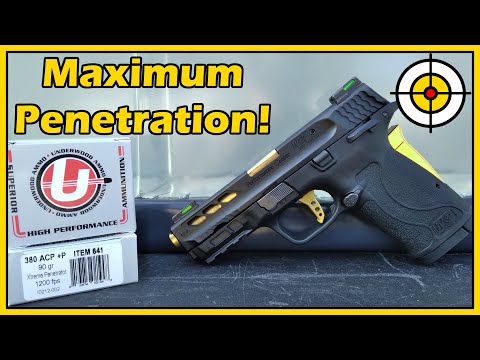
This video details a ballistic gel test of Underwood Xtreme Penetrator ammunition in .380 ACP, comparing standard pressure and +P variants fired from an M&P Shield EZ. The test measured velocity and penetration, revealing impressive performance for both loads, with the standard pressure slightly outperforming the +P in depth. The solid copper projectiles maintained their integrity and created significant wound channels.
Gun Laws by State
Read firearms regulations for all 50 states + D.C.
Find Gun Dealers
Search licensed FFL dealers near you.