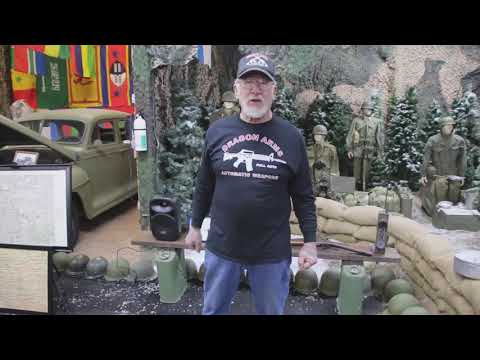
Friday's Tour - 5-20-22

Published on May 21, 2022
Duration: 4:05

This video explores historical military equipment, focusing on American gas masks from WWI to modern times, including rare Belgian baby gas masks and waterproof WWII variants. It also details large caliber artillery pieces like the 106mm, 75mm, and 57mm recoilless rifles, explaining their historical use and permit requirements. Additionally, the presenter showcases a 1943 dog tag machine and discusses the function of dual dog tags, along with a 'Tuxnet Brain' device and the evolution of the scout car into the half-track.


Quick Summary

The video discusses rare Belgian baby gas masks designed for infants with side-mounted charcoal filters. It also covers waterproof rubber gas masks issued to WWII GIs and the function of gas patches that turned blue to indicate chemical agents, signaling the need to wear an M5 gas mask.

Chapters

  1. 00:00Introduction to Gas Mask Collection
  2. 00:05American Gas Masks Through the Years
  3. 00:11Rarest Gas Masks: Belgian Baby Mask
  4. 00:28Waterproof Rubber Gas Mask (WWII)
  5. 00:46WWII Gas Patch Functionality
  6. 01:02Introduction to Large Caliber Guns
  7. 01:12106mm Recoilless Rifle Details
  8. 01:25Korean and Vietnam War Use
  9. 01:36Spotting Rifle Function
  10. 01:4475mm and 57mm Recoilless Rifles (WWII)
  11. 01:17Destructive Device Permit Requirements
  12. 01:271943 Dog Tag Machine
  13. 01:36WWII Dog Tag Purpose Explained
  14. 01:46Tuxnet Brain Device
  15. 01:53Scout Car and Half-track Evolution
  16. 02:13Conclusion and Next Topic

Frequently Asked Questions

What were the rarest types of gas masks discussed in the video?

The video highlights Belgian baby gas masks as exceptionally rare, designed to fit an entire infant with a side-mounted charcoal filter. Waterproof rubber gas masks issued to GIs on D-Day are also noted as uncommon.

How did soldiers know if chemical agents were present in the air during WWII?

Soldiers wore gas patches on their right arm. These patches would turn blue if chemical or biological agents were detected in the air, alerting the soldier to put on their M5 gas mask.

What is a destructive device permit and why is it needed?

A destructive device permit is required for firearms exceeding a 50 caliber diameter or 20mm caliber. These are considered highly regulated items due to their size and potential destructive capability.

What was the purpose of having two dog tags during World War II?

During WWII, soldiers carried two dog tags. One was left with the fallen soldier for identification, while the second was sent to headquarters to officially record their status as deceased.

More General Videos You Might Like

More from Dragonman's

View all →