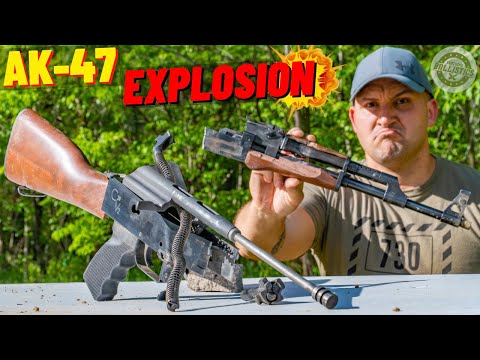
500 Magnum EXPLOSION !!! (When Guns Go Boom – EP 4)

Published on July 27, 2022
Duration: 11:24

This guide details the destructive testing of a Smith & Wesson Model 500 revolver, pushing it to catastrophic failure with an experimental high-pressure round. The process involves securing the firearm, using a ballistic dummy for impact analysis, and remote firing. Post-failure analysis focuses on the extent of structural damage and shrapnel patterns. This expert-level demonstration highlights the extreme forces involved in .500 S&W Magnum cartridges when pushed beyond their design limits.

Quick Summary

A Smith & Wesson Model 500 chambered in .500 S&W Magnum was subjected to extreme pressure testing using an experimental round loaded to 450,000 PSI, far exceeding its normal 60,000 PSI operating limit. This resulted in a catastrophic explosion, destroying the cylinder and damaging the frame, with shrapnel impacting a ballistic dummy.

Chapters

  1. 00:00Introduction and Skit
  2. 01:09Gun Fail Science Experiment Overview
  3. 02:34Power Demonstration
  4. 04:25Sponsor Segment
  5. 05:41Explosion Setup
  6. 07:22The Explosion
  7. 07:56Post-Failure Analysis

Frequently Asked Questions

What is the normal operating pressure for a .500 S&W Magnum round?

A standard .500 S&W Magnum round typically operates at around 60,000 PSI. This is well within the design parameters of firearms like the Smith & Wesson Model 500.

What pressure caused the Smith & Wesson Model 500 to explode?

In this destructive test, an experimental round was loaded to approximately 450,000 PSI, which is seven and a half times the normal operating pressure, leading to catastrophic failure.

What happened to the Smith & Wesson Model 500 during the test?

During the test, the Smith & Wesson Model 500's cylinder detonated due to extreme pressure. The firearm sustained significant damage, including a destroyed cylinder and a snapped frame top strap.

What safety precautions were taken during the .500 S&W Magnum explosion test?

The test was conducted remotely, with the firearm secured in a vice and fired from a safe distance. A ballistic dummy was used to observe impact patterns, and the surrounding area was assessed for shrapnel spread.

Related News

All News →

More Gunsmithing & DIY Videos You Might Like

More from Kentucky Ballistics

View all →