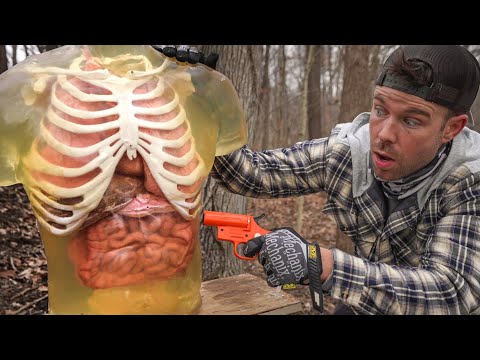
50BMG vs GIANT Clay Block!!! (INSANE)

Published on June 26, 2022
Duration: 8:24

This video demonstrates the effects of various calibers, including 9mm, .223 Remington, and .50 BMG, on large blocks of clay, simulating ballistic testing. The presenter, from 1ShotTV, uses a Glock 19, an AR-15, and a Barrett .50 BMG rifle to shoot 25-pound and later a combined 50-pound block of clay. The experiment highlights how different calibers interact with the dense medium, showing significant expansion and cavity formation, particularly with the .50 BMG round, which surprisingly caused substantial swelling and internal fragmentation without completely obliterating the clay block.

Quick Summary

Clay blocks are employed in ballistic testing to evaluate projectile impact and wound characteristics, mirroring the function of ballistic gel. In this test, a 9mm hollow point created a large wound cavity, a .223 Remington round caused significant fragmentation, and a .50 BMG round resulted in massive swelling and an immense internal cavity within a 50-pound clay block.

Chapters

  1. 00:00Introduction: Giant Clay Block Test
  2. 00:19Clay Block Properties and Purpose
  3. 00:35Clay Block Dimensions and Density
  4. 00:53Shoutout to 704 Tactical
  5. 01:06Plan: Small Calibers to Big Dog
  6. 01:14Unpacking the Clay Blocks
  7. 01:529mm Test: Glock 19 with Federal Punch
  8. 02:179mm Impact and Wound Cavity Analysis
  9. 03:26Reconstructing the Clay Block
  10. 03:42.223 Remington Test: AR-15 with Wolf Steel Case
  11. 04:12.223 Impact and Damage Assessment
  12. 04:59Transition to .50 BMG Test Location
  13. 05:07Preparing the 50-Pound Clay Block
  14. 05:17.50 BMG Test Setup: Barrett and Hornady A-MAX
  15. 05:36Anticipation for the .50 BMG Shot
  16. 05:47.50 BMG Firing Sequence
  17. 05:59.50 BMG Result: Initial Shock
  18. 06:10.50 BMG Backside Examination
  19. 06:19.50 BMG Impact Analysis and Swelling
  20. 06:51.50 BMG Exit Hole and Internal Cavity
  21. 07:00Visualizing the .50 BMG Cavity Size
  22. 07:31Bullet Fragments and Energy Dump
  23. 07:43Unexpected .50 BMG Results
  24. 07:56Conclusion and Future Video Ideas

Frequently Asked Questions

What is the purpose of using clay blocks in ballistic testing?

Clay blocks are utilized in ballistic testing, similar to ballistic gel, to simulate the effects of projectiles on targets. They help assess the damage a bullet inflicts and the characteristics of its wound channel, particularly in contexts like body armor evaluation.

How did the 9mm hollow point perform against the clay block?

The 124-grain Federal Punch hollow-point 9mm round, fired from a Glock 19, created a substantial, cone-shaped wound cavity in the clay block, indicating significant energy transfer and expansion upon impact.

What was the effect of the .223 Remington round on the clay?

The .223 Remington round, fired from an AR-15 using Wolf steel case ammunition, caused considerably more damage than the 9mm. It effectively blew the clay block open, scattering fragments and demonstrating a higher level of destructive power.

Describe the impact of the .50 BMG round on the 50-pound clay block.

The 750-grain Hornady A-MAX .50 BMG round created an enormous entrance hole that doubled in size, causing the 50-pound clay block to swell dramatically. The exit wound was massive, and the internal cavity was exceptionally large, with the bullet fragmenting and dumping significant energy.

More Tactical & Gear Videos You Might Like

More from 1ShotTV

View all →