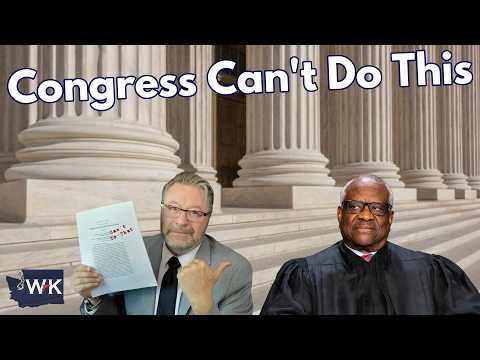
Justice Thomas Says the Commerce Clause Is the REAL Problem

This video analyzes Justice Clarence Thomas's concurrence in the Heimani ruling, focusing on his critique of the Commerce Clause's application to federal firearms laws. Thomas argues that the federal government has overstepped its constitutional authority by using the Commerce Clause to regulate firearm possession, even when the firearm has only crossed state lines historically. The analysis highlights how this interpretation could lead to a significant re-evaluation of federal gun control measures, emphasizing the importance of enumerated powers and the division between federal and state authority.

Quick Summary

Justice Clarence Thomas argues that the federal government's use of the Commerce Clause to regulate firearm possession is unconstitutional. He contends that the historical crossing of state lines by a firearm does not grant perpetual federal authority over its possession, especially when the act of possession is local and not economic, echoing concerns raised in cases like United States v. Lopez.

Chapters

  1. 00:00Intro: Big News from Guns & Gadgets
  2. 00:43The Heimani Ruling and Justice Thomas's Concurrence
  3. 00:55Commerce Clause: The REAL Problem
  4. 01:12Understanding 18 USC 922(g)(3)
  5. 01:41The 'In or Affecting Commerce' Hook
  6. 02:15Thomas: Commerce Clause Exceeds Power
  7. 02:41Limited vs. Unlimited Federal Authority
  8. 03:08What is Commerce? Possession vs. Transaction
  9. 03:32Modern Commerce Clause Doctrine Categories
  10. 03:57Possession is Not Economic Activity
  11. 04:11Lopez and Morrison Precedents
  12. 04:47Federal vs. State Police Power
  13. 05:02The Jurisdictional Hook Debate
  14. 05:37Unlimited Federal Power Danger
  15. 05:52Why Concurrences Matter: Federalism & Liberty
  16. 06:13Bill of Rights and Limited Government
  17. 06:35Thomas's Roadmap for Litigants
  18. 06:41Challenging Federal Gun Laws
  19. 06:55Scarborough v. United States: Statutory vs. Constitutional
  20. 07:24Stakes: Re-examining Federal Gun Control
  21. 07:44Staying Within Constitutional Lanes
  22. 07:54Mission Creep and Federal Overreach
  23. 08:04Heimann Concurrence: A Constitutional Earthquake
  24. 08:35Commerce Clause as a Magic Wand?
  25. 08:44Founders' Understanding of Limited Power
  26. 08:53Thomas Identifies a Constitutional Problem
  27. 09:09Next Wave of Second Amendment Litigation
  28. 09:27Protecting Rights Through Vigilance
  29. 09:40Outro and Call to Action

Frequently Asked Questions

What is Justice Clarence Thomas's main argument regarding the Commerce Clause and federal gun laws?

Justice Thomas argues that the federal government has overextended its authority by using the Commerce Clause to regulate firearm possession. He contends that the historical movement of a firearm across state lines should not grant perpetual federal control over its possession, especially when the possession is purely local and not economic activity.

How does Justice Thomas's concurrence in the Heimani ruling relate to the Second Amendment?

While the main Heimani ruling addressed the Second Amendment rights of marijuana users, Justice Thomas's concurrence broadens the discussion. He suggests that the very foundation of many federal gun laws, built on the Commerce Clause, may be constitutionally suspect, thereby impacting the broader landscape of Second Amendment protections.

What is the significance of the 'in or affecting commerce' phrase in federal firearms statutes?

The phrase 'in or affecting commerce' is the jurisdictional hook federal authorities use to assert power over firearm possession. Thomas argues that this phrase is being interpreted too broadly, allowing regulation of acts that have no direct connection to actual interstate commerce, thereby expanding federal power beyond its constitutional limits.

What legal precedents does Justice Thomas reference in his critique of the Commerce Clause's application to gun laws?

Justice Thomas references United States v. Lopez, where the Supreme Court struck down the Gun-Free School Zones Act, and United States v. Morrison, which limited Congress's power to regulate non-economic activity under the Commerce Clause. He argues that current federal gun possession laws face similar constitutional challenges.

Related News

All News →

More 2nd Amendment & Law Videos You Might Like

More from Guns & Gadgets 2nd Amendment News

View all →