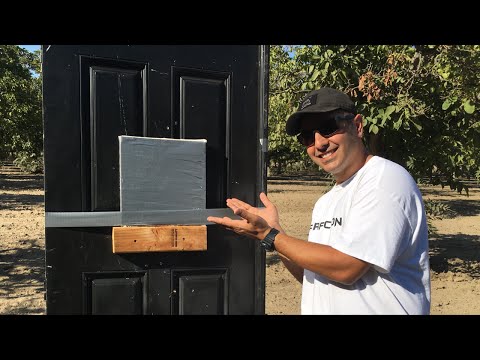
Experimenting with Liquid Metal!!!

Published on November 23, 2021
Duration: 19:14

This video details an experiment by Matt Carriker of DemolitionRanch, demonstrating how liquid metal (gallium) can be used to weaken a solid aluminum block by making it brittle. The process involves applying gallium to a prepared aluminum surface, allowing it to infiltrate the metal's structure over a week, and then testing the block's reduced integrity with various firearms, culminating in the complete destruction of the block by a .50 BMG round. The expert-level demonstration highlights material science principles applied to destructive testing.

Quick Summary

Gallium, a liquid metal with a low melting point, can infiltrate aluminum's grain boundaries, causing liquid metal embrittlement. This process makes the aluminum significantly more brittle and prone to fracture. Experiments show that after gallium treatment, aluminum blocks are easily chipped and eventually shatter upon impact from various firearms, including a .50 BMG round.

Chapters

  1. 00:34Historical Reference: Previous Aluminum Block Test
  2. 01:54Preparation Tools: Grinder and Torch
  3. 05:17Thermal Application: Keeping Gallium Liquid
  4. 10:02Firearm Identification: CZ Scorpion EVO 3
  5. 11:59Ammunition Detail: 5.56mm and .308 Cartridges

Frequently Asked Questions

How does liquid metal affect the strength of aluminum?

Liquid metals like gallium can infiltrate the grain boundaries of aluminum, causing a phenomenon known as liquid metal embrittlement. This process makes the aluminum significantly more brittle and less resistant to fracture, as demonstrated by its easy chipping and eventual shattering after ballistics testing.

What firearms were used to test the gallium-treated aluminum block?

The experiment involved a variety of firearms, starting with smaller calibers like the Ruger Mark I (.22 LR), CZ Scorpion EVO 3 (9mm), and Glock 23 (.40 S&W). It progressed to higher-powered handguns (.44 Magnum) and then rifle calibers including 5.56mm, .308 Winchester, .338 Lapua Magnum (Armalite AR-30), and finally .50 BMG (Barrett M82A1).

What is the melting point of gallium used in the experiment?

Gallium is a non-toxic metal with a low melting point of approximately 85°F (29.8°C). This allows it to be easily liquefied using warm water, making it practical for application in experiments like the one shown.

What was the final result of testing the gallium-treated aluminum block with a .50 BMG round?

Upon impact with a .50 BMG API-T round from a Barrett M82A1, the gallium-treated aluminum block completely shattered into several large pieces. This demonstrated the extreme brittleness induced by the gallium, leading to catastrophic structural failure.

More Gunsmithing & DIY Videos You Might Like

More from DemolitionRanch

View all →