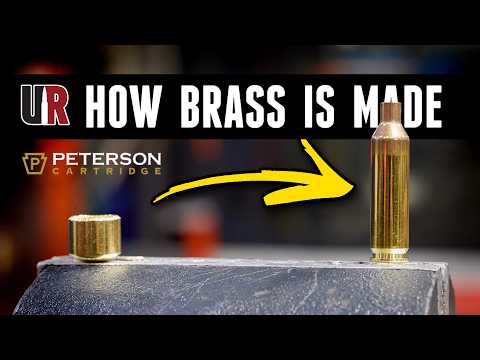
The Peterson Advantage: How Quality Brass is Measured

Published on December 7, 2025
Duration: 17:36

This video provides an in-depth look at Peterson Cartridge's rigorous quality control processes for manufacturing high-quality brass casings. It details methods like sectioning casings to inspect internal structure, measuring primer exit force to assess primer pocket integrity, checking neck tension consistency, and performing hardness tests on the primer pocket region using a Vicor scale. The use of a digital optical comparator for rapid, precise dimensional analysis is also highlighted, emphasizing their commitment to SAAMI specifications and uncompromising quality.


Quick Summary

Peterson Cartridge ensures brass casing quality through multi-stage inspections. This includes sectioning casings for internal analysis, measuring primer exit force to assess primer pocket wear, verifying neck tension consistency with a carbide mandrel, and checking primer pocket hardness via a Vicor scale. A digital optical comparator provides rapid, precise dimensional checks against SAAMI specifications.

Chapters

  1. 00:08Introduction to Ammunition Component Quality
  2. 00:24Tour of Peterson Cartridge Facility with Derek Peterson
  3. 01:02Peterson Cartridge's Mission: Uncompromising Quality
  4. 01:38Behind-the-Scenes Look at Quality Processes
  5. 01:57Starting with Casing Sectioning
  6. 03:08Analyzing Internal Casing Structure
  7. 03:55Potting and Polishing for Inspection
  8. 04:08Measuring Primer Exit Force
  9. 05:38Checking Neck Tension Consistency
  10. 06:11The Role of the Carbide Mandrel
  11. 07:00Hardness Testing the Primer Pocket Region
  12. 08:00Performing Hardness Hits on a 48 Shy Tac
  13. 09:25Introducing the Digital Optical Comparator
  14. 10:00Real-Time Dimensional Analysis with Optical Comparator
  15. 11:16Adhering to SAAMI Print Specifications
  16. 12:04Testing Casings in the Ballistics Lab
  17. 12:30Shooting Test Casings in the Internal Ballistics Lab
  18. 13:10Testing New 6BR Shy Tac Casings
  19. 14:04Utilizing Capabilities for Production and Development
  20. 14:46Automated Inspection and Packaging Process
  21. 15:37Commitment to Uncompromising Quality
  22. 16:06Behind-the-Scenes Access
  23. 16:15How It's Made Video Preview
  24. 16:30Viewer Questions and Comments
  25. 16:51Conclusion and Call to Action

Frequently Asked Questions

How does Peterson Cartridge ensure the quality of its brass casings?

Peterson Cartridge employs rigorous quality control, including sectioning casings for internal inspection, measuring primer exit force, checking neck tension consistency, and performing hardness tests on primer pockets. They also use a digital optical comparator for precise dimensional analysis against SAAMI specifications.

What is primer exit force and why is it important for brass casings?

Primer exit force measures the resistance of the primer pocket to the primer being pushed out after firing. It's crucial for determining primer pocket integrity and how many times a casing can be reliably reloaded. A minimum of around 30 lbs is expected, with lower values indicating wear.

How is neck tension measured and why is it critical for ammunition?

Neck tension is measured using a polished carbide mandrel to ensure consistency. Proper neck tension is vital; too much can damage bullets during seating, while too little can lead to bullets falling out of the casing, affecting both accuracy and safety.

What is the role of a digital optical comparator in brass manufacturing?

A digital optical comparator rapidly captures all critical dimensions of a brass casing with high precision (to 10,000ths of an inch). This technology eliminates operator error, speeds up inspection, and ensures casings meet exact SAAMI specifications.

Does Peterson Cartridge test their brass casings through live firing?

Yes, Peterson Cartridge has an internal ballistics lab where they load and fire their casings to test their performance in real-world conditions. This ensures that the casings not only meet dimensional and material standards but also function reliably.

More Gunsmithing & DIY Videos You Might Like

More from Ultimate Reloader

View all →