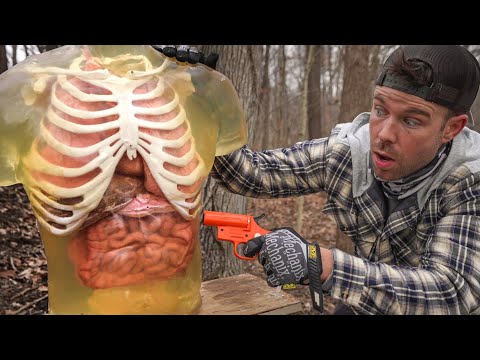
Hornady Critical Duty vs HARD BARRIERS

Published on July 15, 2018
Duration: 10:10

This video provides a comprehensive ballistic test of Hornady Critical Duty 9mm Luger 135 grain FlexLock ammunition against various hard barriers, including wood, glass, steel, and concrete. The tests, conducted by an experienced instructor, demonstrate the ammunition's 'barrier blind' design, showing its ability to penetrate these materials while maintaining terminal performance in ballistics gel. The concrete test proved the most challenging, resulting in fragmentation, while other barriers showed varying degrees of expansion and penetration.

Quick Summary

Hornady Critical Duty 9mm Luger 135 grain FlexLock ammunition is designed to be 'barrier blind,' successfully penetrating wood, glass, and steel barriers while maintaining terminal performance in ballistics gel. Penetration depths varied, with glass yielding 15 inches and steel/wood around 11 inches. Extreme barriers like concrete caused fragmentation.

Chapters

  1. 00:00Intro: Critical Duty Ammo & Test Overview
  2. 00:30Test Setup: Barriers & Ballistics Gel
  3. 00:49Wood Barrier Test Setup & Shot
  4. 01:49Wood Barrier Test Results & Analysis
  5. 02:39Glass Barrier Test Setup & Shot
  6. 03:44Glass Barrier Test Results & Analysis
  7. 04:33Steel Barrier Test Setup & Shot
  8. 05:35Steel Barrier Test Results & Analysis
  9. 06:19Concrete Barrier Test Setup & Shot
  10. 07:19Concrete Barrier Test Results & Analysis
  11. 08:03Recovered Bullet Analysis
  12. 09:26Overall Conclusion & Performance

Frequently Asked Questions

How does Hornady Critical Duty 9mm ammunition perform against hard barriers?

Hornady Critical Duty 9mm Luger 135 grain FlexLock ammunition is designed to be 'barrier blind.' Tests show it successfully penetrates wood, glass, and steel, maintaining expansion in ballistics gel. However, extreme barriers like thick concrete can cause fragmentation.

What is the penetration depth of Hornady Critical Duty 9mm in ballistics gel after passing through barriers?

After passing through a wood plank, the 9mm Critical Duty penetrated about 10.5-11 inches. Through glass, it reached 15 inches. Through steel, it stopped at approximately 11 inches. Through concrete, fragmentation occurred with the largest piece stopping around 11 inches.

Is Hornady Critical Duty suitable for self-defense against vehicles?

Yes, the Critical Duty is designed for barrier penetration, including car windshields and doors. The tests demonstrated its ability to pass through glass and still perform effectively in ballistics gel, making it a viable option for self-defense scenarios involving vehicles.

What happens to Hornady Critical Duty bullets after hitting concrete?

When fired through a 2-inch concrete block, the Hornady Critical Duty 9mm bullet fragmented significantly. While the largest fragment stopped around 11 inches in ballistics gel, the bullet did not remain intact, indicating concrete is a very challenging barrier.

More Tactical & Gear Videos You Might Like

More from 1ShotTV

View all →