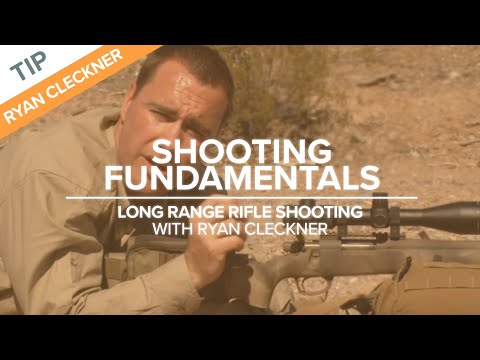
Understanding Mils (Milliradians) | Long-Range Rifle Shooting with Ryan Cleckner

This guide details how to use milliradians (mils) for accurate range estimation and holdover adjustments in long-range shooting, as explained by former sniper Ryan Cleckner. It covers the fundamental mil relationship, range formulas for both yards and inches, and the practical application of mil-dots in reticles for compensating bullet drop and windage. Cleckner, a recognized expert, emphasizes the importance of understanding focal planes (FFP vs. SFP) for consistent mil readings.

Quick Summary

Milliradians (mils) are angular measurements crucial for long-range shooting. 1 mil equals 1/1000th of a radian, meaning 1 mil subtends 1 yard at 1,000 yards. This allows for range estimation using formulas like (Target Height in Yards x 1000) / Mils Read = Distance in Yards. Mils are also used for holdovers to compensate for bullet drop and windage, offering faster target engagement.

Chapters

  1. 00:00Introduction to Milliradians
  2. 00:47Defining a Mil
  3. 02:24The Range Estimation Formula
  4. 03:32Reading the Reticle
  5. 07:23Focal Planes and Magnification
  6. 10:15Inches-to-Yards Formula
  7. 15:30Mils vs. MOA Conversion
  8. 17:02Elevation and Windage Holdovers

Frequently Asked Questions

What is a milliradian (mil) in shooting?

A milliradian (mil) is an angular measurement where 1 mil equals 1/1000th of a radian. This means at 1,000 yards, 1 mil subtends exactly 1 yard (36 inches), forming the basis for range estimation formulas in long-range shooting.

How do you estimate range using a mil-dot reticle?

To estimate range, measure the target's height in mils using your reticle. Then, use the formula: (Target Height in Yards x 1000) / Mils Read = Distance in Yards. Ensure your scope's magnification is correct for accurate readings, especially with SFP scopes.

What is the difference between FFP and SFP scopes for mil usage?

First Focal Plane (FFP) scopes display accurate mil spacing at all magnifications, ideal for consistent rangefinding and holdovers. Second Focal Plane (SFP) scopes typically only offer accurate mil readings at a specific magnification, often the highest setting.

How can mils be used for bullet drop and windage?

Mils allow for 'holdover' aiming. By calculating the required bullet drop or windage correction in mils, shooters can use the reticle's dots or hash marks as precise aiming points, enabling faster target engagement without adjusting scope turrets.

Related News

All News →

More Training & Techniques Videos You Might Like

More from NSSF—The Firearm Industry Trade Association

View all →