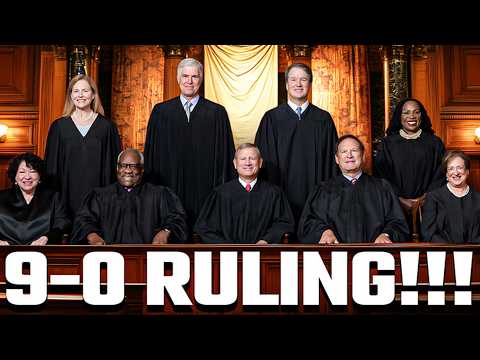
Supreme Court Issues Unanimous Decision With Nationwide & Constitutional Implications! What Now?

Published on May 31, 2026
Duration: 8:20

This video details the ongoing legal battle of the Martin family, who were victims of a mistaken FBI raid. It explains the Supreme Court's unanimous ruling that government immunity doesn't automatically apply when law enforcement exercises discretion, emphasizing the need for policy considerations over mere mistakes. The analysis highlights a new 5th Circuit ruling that distinguishes between policy decisions and operational failures, providing further support for the Martin family's argument that raiding the wrong house is not protected by the discretionary function exception.


Quick Summary

The Supreme Court unanimously ruled that government immunity under the discretionary function exception does not automatically apply when law enforcement exercises judgment. The government must demonstrate that decisions were grounded in actual policy considerations, not just mistakes. A new 5th Circuit ruling further distinguishes between policy decisions and operational failures, impacting cases like the FBI's wrong house raid on the Martin family.

Chapters

  1. 00:00Introduction: Wrong House Raid Scenario
  2. 00:51Sponsor: TacPac Tactical Gear Subscription
  3. 01:32The Martin Family's Supreme Court Victory
  4. 02:17Details of the FBI Raid on the Martin Home
  5. 02:55The Lawsuit and Government Immunity Defense
  6. 03:17Supreme Court Ruling on Discretionary Function
  7. 03:4211th Circuit Re-Review and Key Questions
  8. 04:24New 5th Circuit Ruling: Morris v. United States
  9. 04:53Distinction: Policy vs. Execution Failure
  10. 05:12Martin Family's Argument: Operational Failure
  11. 05:44Supplemental Filing and Momentum
  12. 06:15The Overarching Question for the 11th Circuit
  13. 06:44Conclusion and Call to Action

Frequently Asked Questions

What was the Supreme Court's ruling regarding the FBI's wrong house raid on the Martin family?

The Supreme Court issued a unanimous nine-to-zero ruling in favor of the Martin family. They clarified that government immunity under the discretionary function exception is not automatic; the government must prove decisions were based on policy considerations, not mere mistakes.

How does the 5th Circuit's ruling in Morris v. United States impact the Martin family's case?

The 5th Circuit ruled that a failure to properly execute a policy decision is not automatically protected by immunity. This distinction between making a policy choice and botching its execution supports the Martin family's argument that the FBI's actions were operational failures, not protected policy judgments.

What is the core legal issue the 11th Circuit must decide in the Martin family's case?

The central question for the 11th Circuit is whether the government can claim immunity when FBI agents raid the wrong house. This involves determining if the actions taken during the raid constitute protected discretionary functions or unprotected operational failures.

What is the discretionary function exception in the context of the Federal Torts Claims Act?

The discretionary function exception to the FTCA shields the government from liability for actions involving judgment or choice. However, the Supreme Court has clarified that this exception requires a showing of actual policy considerations, not just simple mistakes or negligence in execution.

Related News

All News →

More 2nd Amendment & Law Videos You Might Like

More from Armed Scholar

View all →