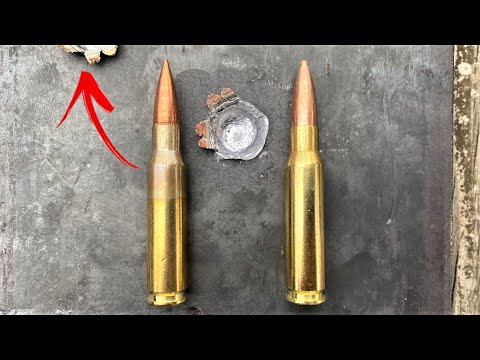
223 vs 5.56: Can’t Believe The Difference

Published on February 16, 2024
Duration: 11:59

This video provides an in-depth, experimental comparison between .223 Remington and 5.56x45mm NATO cartridges, utilizing a chronograph and various barrier materials. The host, demonstrating high expertise through empirical testing, reveals significant performance differences, particularly in barrier penetration, with 5.56x45mm NATO generally outperforming .223 Remington.

Quick Summary

Expert analysis reveals significant performance differences between .223 Remington and 5.56x45mm NATO. Empirical testing using chronographs and various barriers showed 5.56 NATO consistently outperforming .223 Remington in velocity, energy, and barrier penetration, particularly against steel and lumber.

Chapters

  1. 00:00Introduction and Visual Comparison
  2. 00:26Velocity and Energy Testing
  3. 01:16Round 1: Lumber and Mild Steel
  4. 03:33Round 2: Sand Barrier
  5. 06:58Round 3: Concrete Barrier
  6. 08:37Round 4: Steel Penetration Depth

Frequently Asked Questions

What is the main difference between .223 Remington and 5.56x45mm NATO ammunition?

.223 Remington and 5.56x45mm NATO cartridges are visually similar but differ in pressure and velocity. 5.56 NATO generally operates at higher pressures and velocities, leading to superior barrier penetration compared to .223 Remington in empirical tests.

How does 5.56 NATO perform against barriers compared to .223 Remington?

In testing, 5.56x45mm NATO rounds demonstrated significantly better barrier penetration. They successfully penetrated lumber and mild steel where .223 Remington rounds failed to penetrate the steel, indicating a clear performance advantage.

Which ammunition type is better for penetrating barriers like steel or concrete?

Based on empirical testing, 5.56x45mm NATO, especially specialized rounds like the M855A1, shows superior barrier penetration capabilities compared to standard .223 Remington ammunition. This makes it a more effective choice for challenging penetration scenarios.

What testing methods were used to compare .223 Remington and 5.56x45mm NATO?

The comparison utilized a chronograph to measure average velocity and energy, alongside controlled barrier testing against materials such as pressure-treated lumber, mild steel, sand, and concrete blocks to assess penetration and performance.

Related News

All News →

More Tactical & Gear Videos You Might Like

More from Banana Ballistics

View all →